- Phone:+86-17331948172 +86-0319-8862898
- E-mail: inquiry@puxingclamp.com

Oct . 10, 2025 11:40 Back to list
Stainless Steel Hose Clamp: Rust-Proof, Adjustable—Why Us?
The Practical Guide to Choosing a Stainless Steel Hose Clamp That Won’t Let You Down
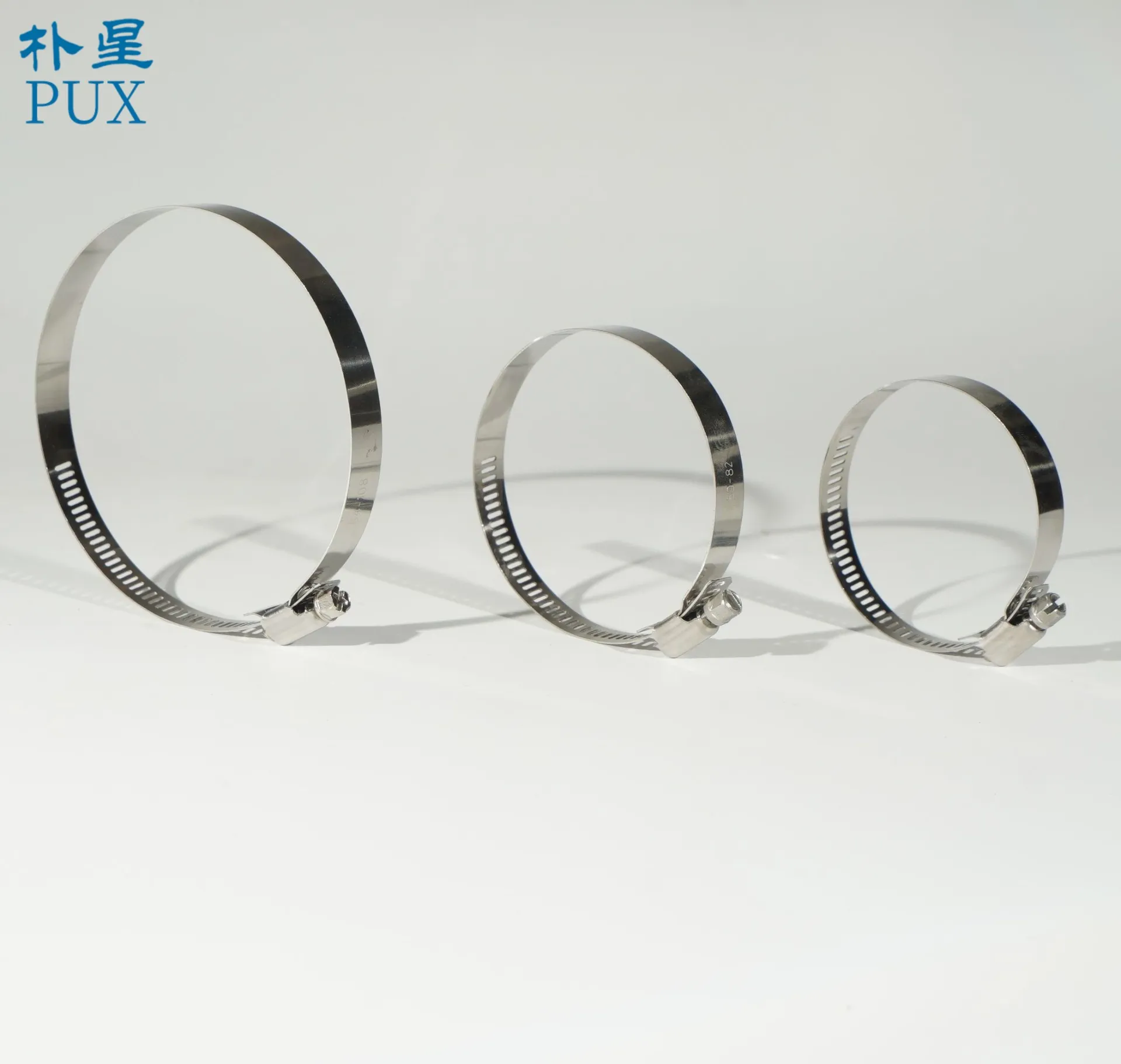
If you work with fluid lines long enough, you learn one truth: the tiny parts cause the biggest headaches. That’s why I pay extra attention to the humble stainless steel hose clamp. Built right, it stays quiet for years. Built wrong, it ruins your Monday. The model coming out of East Zhaozhuang Village, Shahe Town, Xingtai City, Hebei Province, China has impressed me lately—strong anti-rust performance, smooth band edges that don’t scar hoses, and yes, reusable without drama.
What’s trending in clamps right now
Short version: corrosion resistance and traceability. Marine and food processors are pushing SS316; automotive and HVAC still do well with SS304. Everyone asks for cleaner edges, higher torsion, and faster installation. Also, sustainability is creeping in—suppliers tout RoHS/REACH compliance, recyclable packaging, and longer service life to cut replacements. Honestly, it’s overdue.
Product snapshot (real-world values)
| Material options | SS201 (budget), SS304 (general), SS316 (marine/food) |
| Band width | 8–12 mm common; customs available |
| Diameter range | 8–300 mm standard, larger on request |
| Tightening torque | ≈3–7 N·m (depends on size and screw) |
| Salt-spray (NSS) | SS201 ≈240 h; SS304 ≈480–600 h; SS316 ≈800–1000 h |
| Working temp | around -40°C to +200°C; use case may vary |
| Standards touchpoints | DIN 3017, SAE J1508, ISO 9227/ASTM B117 (tests) |
In daily use, the stainless steel hose clamp here tightens fast, holds torque well, and the smooth band edge genuinely reduces hose bite. Many customers say they reuse them during maintenance without thread slippage—always nice to hear.
How it’s made (and why it matters)
Materials: SS304/316 bands, matching housings; screws usually SS410 or SS304, depending on torque targets. Methods: precision stamping, perforation or embossing, housing forming, thread rolling, deburring (this is key), and passivation for corrosion resistance. Testing: torque-to-slip, tensile load per DIN 3017 guidelines, 24–96 h lot verification in salt-spray (ISO 9227/ASTM B117), dimensional checks. Service life: ≈5–10 years in moderate environments; marine/chemical areas favor SS316 for obvious reasons. To be honest, process control beats marketing every time.
Where it shines
- Automotive coolant and turbo plumbing, HVAC ducts, irrigation lines
- Marine pumps and bilge systems (go SS316), food and beverage washdown, pharma utilities
- MRO kits—techs appreciate a stainless steel hose clamp that tightens smoothly and doesn’t chew the hose.
Extra perks: attractive finish, easy operation, high free/overall torsion, stable, quick tightening, and yes—the band can be reused if not overstressed.
Vendor snapshot (quick comparison)
| Vendor | Materials | Widths | MOQ | Lead time | Certs | Notes |
|---|---|---|---|---|---|---|
| Puxing (Hebei) | SS201/304/316 | 8–12 mm | ≈2,000 pcs | ≈2–4 weeks | ISO 9001, RoHS/REACH | Smooth edges, stable torque |
| Global Brand A | SS304/316 | 7–14 mm | Varies | Stock–4 weeks | ISO 9001 | Premium pricing |
| Local Distributor B | Mixed | Common sizes | Low | Immediate | — | Convenient, variable quality |
Customization and real cases
Customization: band embossing vs perforation, worm-drive screw head (slotted/hex), laser marking for traceability, special diameters, higher torque screws, kits. Lead times are reasonable, to be honest.
Case 1 (Food plant): Switched to SS316 stainless steel hose clamp in washdown areas; maintenance reports a drop in retightening calls and cleaner hose surfaces after 8 months.
Case 2 (Marine service): A contractor standardised on SS316 for bilge/engine hoses. After ≈12 months, salt-spray pitting on previous stock vanished from reports—simple win.
Proof points
- Internal tests: torque-to-slip within spec; salt-spray benchmarks as above (reports on request).
- Compliance: ISO 9001 QMS; RoHS/REACH statements available. Stainless steel hose clamp quality correlates strongly with deburring and passivation—don’t skip that in RFQs.
Authoritative references
-
Reliable Earls Hose Clamps for Industrial Applications – Trusted by Experts
NewsDec.09,2025
-
High-Performance Ear Type Hose Clamps for Industrial Use | Puxing Clamp
NewsDec.09,2025
-
Durable Ear Style Hose Clamps | Industrial-Grade Reliability
NewsDec.09,2025
-
Ear Hose Clamps: Durable, Cost-Effective Solutions for Industrial Applications | Puxing Clamp
NewsDec.08,2025
-
Expert Guide to Ear Hose Clamp Removal Techniques and Tools
NewsDec.08,2025
-
Comprehensive Guide to Ear Hose Clamp Pliers: Global Applications & Advantages
NewsDec.08,2025
 English
  Afrikaans
  Albanian
  Amharic
  Arabic
  Armenian
  Azerbaijani
  Basque
  Belarusian
  Bengali
  Bosnian
  Bulgarian
  Catalan
  Cebuano
  Corsican
  Croatian
  Czech
Czech  Danish
  Dutch
Dutch  Esperanto
  Estonian
  Finnish
  French
  Frisian
  Galician
  Georgian
  German
  Greek
Greek  Gujarati
  Haitian Creole
  Hausa
Hausa  Hawaiian
  Hebrew
  Hindi
Hindi  Miao
Miao  Hungarian
  Icelandic
  Igbo
Igbo  Indonesian
  Irish
Irish  Italian
  Japanese
  Javanese
  Kannada
  Kazakh
  Khmer
Khmer  Rwandese
  Korean
  Kurdish
  Kyrgyz
  Lao
Lao  Latin
Latin  Latvian
  Lithuanian
  Luxembourgish
  Macedonian
  Malgashi
  Malay
Malay  Malayalam
  Maltese
  Maori
Maori  Marathi
  Mongolian
  Myanmar
  Nepali
  Norwegian
  Norwegian
  Occitan
  Pashto
  Persian
  Polish
  Portuguese
  Punjabi
  Romanian
  Russian
  Samoan
  Scottish Gaelic
  Serbian
  Sesotho
  Shona
Shona  Sindhi
  Sinhala
  Slovak
  Slovenian
  Somali
  Spanish
  Sundanese
  Swahili
  Swedish
  Tagalog
  Tajik
Tajik  Tamil
Tamil  Tatar
Tatar  Telugu
  Thai
Thai  Turkish
  Turkmen
  Ukrainian
  Urdu
Urdu  Uighur
  Uzbek
Uzbek  Vietnamese
  Welsh
Welsh  Bantu
Bantu  Yiddish
  Yoruba
  Zulu
Zulu