- Phone:+86-17331948172 +86-0319-8862898
- E-mail: inquiry@puxingclamp.com

Apr . 25, 2026 10:42 Ar ais chuig an liosta
What Is a Hose Clamp? Types, Applications & Ultimate Selection Guide
What Is a Hose Clamp?
A hose clamp (also known as a hose clip, hose lock, or pipe clamp) is a circular fastening device used to attach and seal a flexible hose onto a fitting such as a barb, nipple, or spigot. Its primary purpose is to prevent the hose from slipping off the fitting and to stop the leakage of fluids or gases at the connection point.
Despite their small size and relatively low cost, hose clamps play an enormous role in system safety and reliability. They work by applying uniform radial pressure around the circumference of the hose, creating a tight seal that withstands vibration, temperature changes, and pressure fluctuations.
Common Applications Across Industries
Hose clamps are used in virtually every industry that involves the transfer of liquids, gases, or air. Here are the most common applications:
| Industry | Typical Applications |
|---|---|
| Automotive | Radiator hoses, coolant systems, fuel lines, air intake systems, brake lines, turbocharger connections |
| Plumbing & Residential | Garden hoses, washing machines, dishwashers, water heaters, irrigation systems |
| Industrial Manufacturing | Hydraulic systems, pneumatic lines, chemical transfer, dust collection systems, food processing equipment |
| Agriculture | Irrigation systems (sprinklers, drip lines), fertilizer and pesticide sprayers, livestock watering systems |
| HVAC | Ductwork connections, refrigerant lines, ventilation systems |
| Marine | Bilge pumps, fuel lines, engine cooling, seawater systems |
| Food & Beverage | Sanitary hose connections in wineries, breweries, food processing plants |
In the automotive sector, hose clamps secure fuel lines, radiator hoses, and air intake systems to ensure systems operate efficiently and safely. In industrial settings, they are used in hydraulic and pneumatic systems where reliability is critical to prevent costly downtime. Understanding your application‘s pressure, temperature, and environmental conditions is the first step to selecting the right clamp.
Main Types of Hose Clamps
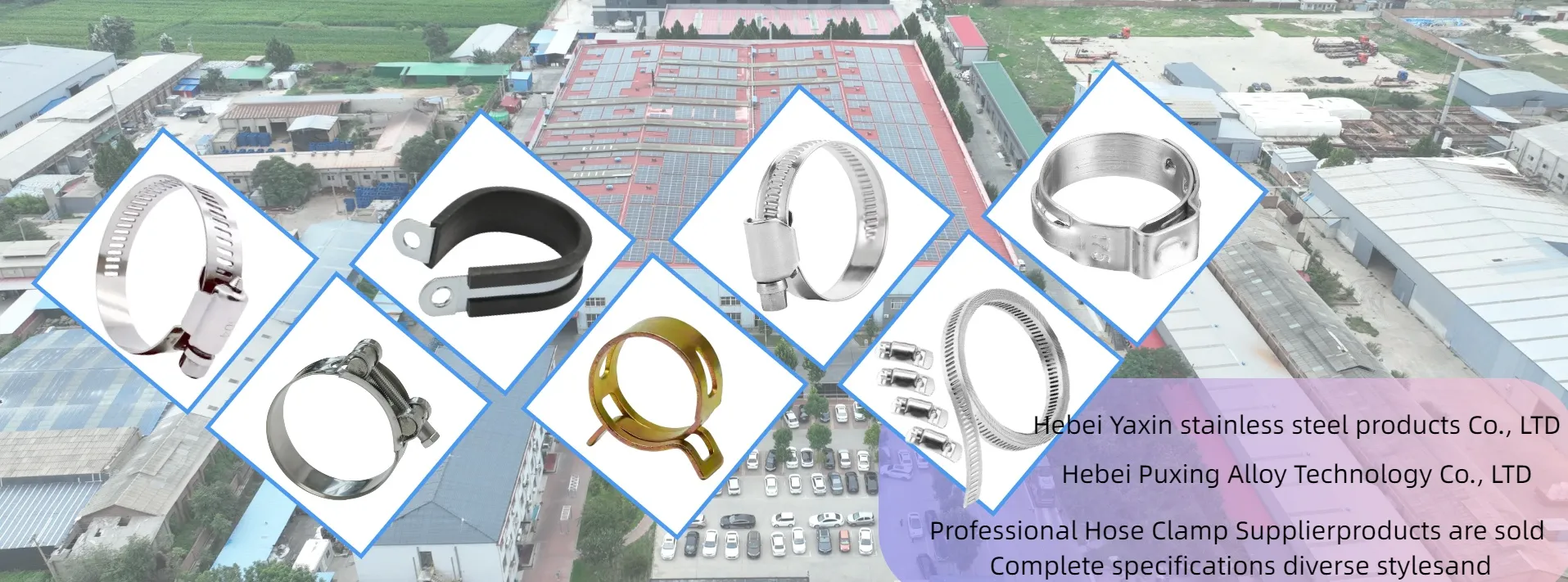
There are many types of hose clamps, each designed for specific pressure ranges, installation requirements, and durability needs. Below are the most common types you’ll encounter in the market.
1. Worm Gear Clamps (Screw Clamps)
Worm gear clamps are the most widely used type of hose clamp. They consist of a slotted metal band with a screw mechanism that tightens the band around the hose. Turning the screw draws the band through the gear housing, providing a secure adjustable fit.
Advantages: Easy to install, adjustable, reusable, suitable for a wide range of hose diamters
Best for: General-purpose applications in automotive, plumbing, and industrial systems where moderate pressure is present
Considerations: Over-tightening can damage the hose; not ideal for very high-pressure applications
2. T-Bolt Clamps
T-bolt clamps feature a solid metal band pulled tight by a T-shaped bolt and nut assembly. They deliver significantly higher and more uniform clamping force compared to worm gear clamps, making them the go-to choice for heavy-duty applications.
Advantages: High torque capacity, uniform pressure distribution, reusable, excellent vibration resistance
Best for: High-pressure systems, turbocharger connections, heavy-duty industrial applications
Considerations: More expensive than worm gear clamps; requires more space for installation
3. Spring Clamps (Constant-Tension Clamps)
Spring clamps use a spring-loaded mechanism to maintain consistent clamping force even when temperature changes cause the hose material to expand or contract. Made from a single piece of spring steel, they typically feature a C-shape with two tangs that can be squeezed for installation.
Advantages: Self-adjusts to temperature fluctuations, consistent tension over time
Best for: Engine cooling systems, automotive radiators, dishwashers and appliances
Considerations: Can be challenging to install without special tools; limited adjustability
4. Ear Clamps
Ear clamps are single-use clamps that are crimped onto a hose using a special pincer tool. They feature one or two “ears” that are compressed to provide a permanent, tamper-proof seal.
Advantages: Low profile, permanent and reliable seal, tamper-proof, clean appearance
Best for: Pneumatic and hydraulic systems, automotive fuel lines, applications where the clamp won‘t need to be removed
Considerations: Not reusable; requires special installation tool
5. Band Clamps
Band clamps use a wide stainless steel band and are suitable for large-diameter hoses. They are often used in agricultural and industrial applications. When using multiple band clamps, they should be offset on the hose by at least 90° to distribute clamping force evenly.
Advantages: Even pressure distribution, ideal for large diameters
Best for: Large-diameter hoses, agricultural irrigation systems, industrial applications
Considerations: Requires band clamp hand tool for proper installation
6. Wire Clamps (Double Wire Clamps)
Wire clamps consist of two wire loops that apply even pressure around the hose. They are designed to minimize the risk of hose damage through even pressure distribution.
Advantages: Simple design, even pressure distribution, minimizes hose damage
Best for: Low-pressure applications such as garden hoses, irrigation systems
Considerations: Limited to low-pressure applications; may require special pliers
Hose Clamp Materials: Which One Is Right for You?
The material of a hose clamp directly determines its corrosion resistance, temperature tolerance, and overall durability. Material selection should be based on the operating environment and the media being transferred.
304 stainless steel is the most widely used material for hose clamps, offering excellent corrosion resistance for most industrial and automotive applications. For marine environments, food processing, or chemical plants, upgrade to 316 stainless steel—it contains molybdenum, which provides superior resistance to chlorides and saltwater. For dry, indoor applications where corrosion isn‘t a concern, zinc-plated steel offers a cost-effective solution.
How to Choose the Right Hose Clamp:
Selecting the right hose clamp is critical to system reliability. Follow this step-by-step framework to ensure you make the best choice.
Step 1: Measure the Hose Diameter Correctly
Measure the installed outside diameter (OD) of the hose once it is fully seated on the fitting—not the nominal hose size. Use calipers or a diameter tape for accuracy. Choose a clamp whose effective working range comfortably covers this measured OD, ideally with the hose size falling in the middle of the clamp‘s adjustment range.
Step 2: Determine the Correct Band Width
Soft materials (rubber, plastic, silicone): Select wider band clamps to distribute clamping force and prevent hose deformation
Hard materials (metal, rigid pipes): Narrower band clamps can be used since the hose won‘t deform easily
Step 3: Select the Right Material Based on Environment
Wet, outdoor, or chemical exposure: 304 or 316 stainless steel
Dry, indoor, non-corrosive: Zinc-plated carbon steel
High-temperature applications: Stainless steel (304 withstands up to 427°C / 800°F)
Step 4: Match the Clamp Type to Pressure Requirements
Low pressure (air, water, light-duty): Worm gear clamps, wire clamps
Medium pressure (coolant, fuel, moderate hydraulics): Heavy-duty worm gear clamps, spring clamps
High pressure (turbo systems, industrial hydraulics): T-bolt clamps or constant-tension clamps
Installation Best Practices
Proper installation is just as important as selecting the right clamp. Follow these tips for maximum performance:
Lubricate the hose fitting slightly before sliding the hose on to ensure full seating
Position the clamp over the barbed or ribbed section of the fitting—not at the very end of the hose
Tighten to the manufacturer‘s recommended torque specification—over-tightening can damage the hose, while under-tightening leads to leaks
Apply torque gradually and evenly—typical torque values range from 3 Nm for 8–12mm hoses to 6 Nm for 35–45mm hoses
Inspect after installation for any signs of hose bulging or compression damage
Frequently Asked Questions (FAQ)
Q: Can I reuse a hose clamp?
A: It depends on the type. Worm gear clamps and T-bolt clamps are reusable. Ear clamps and spring clamps are typically single-use and should be replaced after removal.
Q: What‘s the difference between 304 and 316 stainless steel hose clamps?
A: 316 stainless steel contains molybdenum, offering superior corrosion resistance in saltwater, chemical, and high-humidity environments. Use 304 for general-purpose applications and 316 for marine or chemical exposure.
Q: How do I know if my hose clamp is tight enough?
A: For worm gear clamps, use a torque wrench to apply the manufacturer‘s recommended torque value. A properly tightened clamp will not spin around the hose but will not visibly compress the hose material.
Q: What size hose clamp do I need?
A: Measure the outside diameter of the hose when seated on the fitting, then select a clamp whose adjustment range covers that measurement with the hose size in the middle of the range.
Q: Are plastic hose clamps as strong as metal ones?
A: Plastic clamps are suitable for lightweight, low-pressure, or electrical insulation applications but do not match the strength, heat tolerance, or pressure capacity of metal clamps.
Conclusion
Hose clamps may be small components, but they are absolutely essential to the safety, efficiency, and reliability of countless systems across automotive, industrial, agricultural, and residential applications. Choosing the right hose clamp comes down to knowing your application—the pressure, temperature, media, and environment—and then matching those requirements to the correct type, material, and size.
We hope this guide has helped you understand the world of hose clamps. If you have questions or need assistance selecting the right hose clamp for your specific application, [contact our team / request a quote].
Is é seo an t-alt deiridh
-
How to Use a Hose Clamp? Complete Installation Guide & Practical Tips
NuachtApr.01,2026
-
What Is a Hose Clamp? Types, Applications & Ultimate Selection Guide
NuachtApr.25,2026
-
What Is a Heavy Duty Hose Clamp?
NuachtMar.16,2026
-
Why Zinc-Plated Screws Matter for German-Type Hose Clamps
NuachtMar.13,2026
-
Engine Piping Safety First: Complete Guide to Hose Clamp Selection and Installation
NuachtMar.09,2026
-
5 Common Mistakes When Installing Hose Clamps & How to Do It Right
NuachtMar.06,2026
 Irish
Irish  English
  Afrikaans
  Albanian
  Amharic
  Arabic
  Armenian
  Azerbaijani
  Basque
  Belarusian
  Bengali
  Bosnian
  Bulgarian
  Catalan
  Cebuano
  Corsican
  Croatian
  Czech
Czech  Danish
  Dutch
Dutch  Esperanto
  Estonian
  Finnish
  French
  Frisian
  Galician
  Georgian
  German
  Greek
Greek  Gujarati
  Haitian Creole
  Hausa
Hausa  Hawaiian
  Hebrew
  Hindi
Hindi  Miao
Miao  Hungarian
  Icelandic
  Igbo
Igbo  Indonesian
  Italian
  Japanese
  Javanese
  Kannada
  Kazakh
  Khmer
Khmer  Rwandese
  Korean
  Kurdish
  Kyrgyz
  Lao
Lao  Latin
Latin  Latvian
  Lithuanian
  Luxembourgish
  Macedonian
  Malgashi
  Malay
Malay  Malayalam
  Maltese
  Maori
Maori  Marathi
  Mongolian
  Myanmar
  Nepali
  Norwegian
  Norwegian
  Occitan
  Pashto
  Persian
  Polish
  Portuguese
  Punjabi
  Romanian
  Russian
  Samoan
  Scottish Gaelic
  Serbian
  Sesotho
  Shona
Shona  Sindhi
  Sinhala
  Slovak
  Slovenian
  Somali
  Spanish
  Sundanese
  Swahili
  Swedish
  Tagalog
  Tajik
Tajik  Tamil
Tamil  Tatar
Tatar  Telugu
  Thai
Thai  Turkish
  Turkmen
  Ukrainian
  Urdu
Urdu  Uighur
  Uzbek
Uzbek  Vietnamese
  Welsh
Welsh  Bantu
Bantu  Yiddish
  Yoruba
  Zulu
Zulu